

Julien Jaubert
© DR
The artistic residency blog
Each artistic research residency at IRCAM is unique. Yet with his project “Ruptures”, Julien Jaubert is truly tearing down the walls between genres, by inviting rap artists into IRCAM’s studios. Also known as Shkyd, Jaubert shares the research themes he intends to explore during his time with the Sound Music Movement Interaction team.
In many regards, Julien Jaubert’s musical background makes him the perfect bridge between the world of IRCAM and that of rap music. Raised by a musical family – his father was a producer and music publisher in the 1970s – he learnt the piano and the violin at the conservatory and even got introduced to computer-assisted composition by his older brother. Growing up, he turned to more contemporary music, mostly rap. He tried his hand at every trade, and he was successively or simultaneously: sound engineer, author, producer, publisher, and even reviewer. For more than 10 years, he mastered every job in the industry – apart from performing – which allowed him to build an impressive professional network in France and abroad. His panoptic vision and exceptional network are part of the reason researcher Jérôme Nika reached out to him, with the idea of testing the new interactive software developed by the Interaction Son Musique Mouvement team, to work with artists from the rap scene, a musical genre that he had not yet explored.
“The main question we are asking is whether the new interactive software developed by Jérôme Nika can work with this musical aesthetic" explains Julien Jaubert.“What can it bring to the table? Dealing with rap music is especially tricky compared to other genres, because it requires using a tape that cannot be interrupted; the performer needs it to find their flow. This new software is a game-changer, as it allows interaction with the tape, which creates a unique, more organic dimension, especially when playing live, but also reduces the constraints that can weight on a performance, at the start, transition, or ending of a song.”
Julien Jaubert
Music producer and publisher
From this idea, Julien Jaubert’s residency was born. It follows a purely experimental protocol: Jaubert is inviting, among the artists he knows, the most curious to come to IRCAM to discover and experiment with Dyci2. “My role is first and foremost to act as an intermediary. I invite the artists and try teaching them in simple terms how to get familiar with the tool. I explain to them how it works and all the possibilities it offers, before stepping back to observe and analyse how they use it. In a way, that is exactly what I do when I’m working in the studio. Because I am a producer and not a performer, there is an educational aspect to my work that enables me to identify tools and techniques that could be useful to artists or performers. Still, in the context of this residency, my position can be slightly precarious because I need to remain perfectly neutral, both in my explanations and feedback.” The task gets even more complicated when considering how fragmented the rap scene is, divided (but not exclusively) into two main categories: studio production and live performance.
“The creators I am inviting have different approaches to making music, and the tool won’t be used in the same way in the studio or on stage. The same goes when comparing artists who specialize in what could be called “street rap” or slam, and are therefore more into improvising, with those who dream of making their mark in the history of a specific movement or who want to play with instruments – and these categories of course do not exclude each other. Some have a more instinctive approach than others, and so their experience with the tool won’t be the same.”
Julien Jaubert
Music producer and publisher
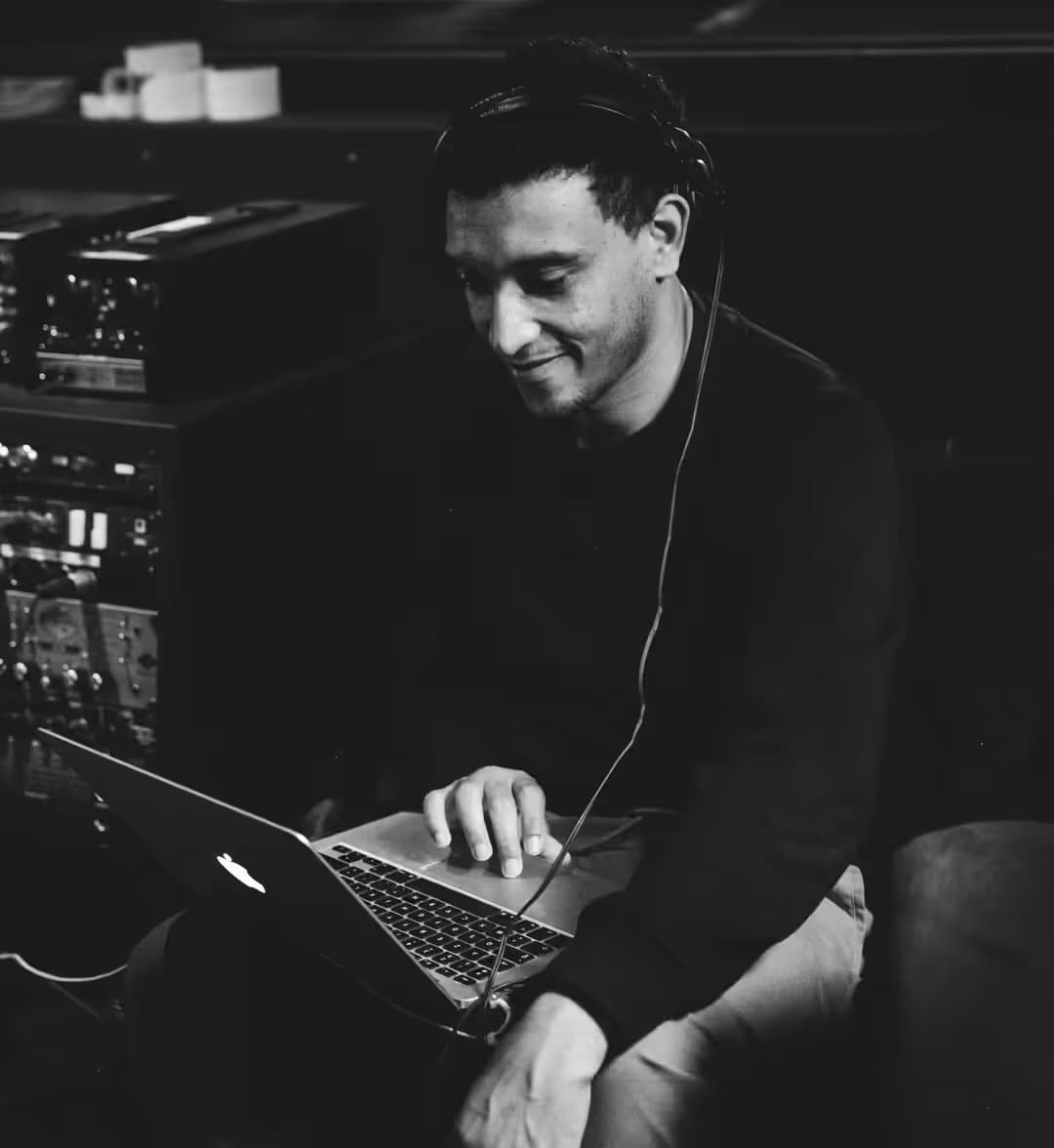 Shkyd, Julien Jaubert © DR
Moreover, the rap scene relies heavily on composers, who are the ones producing the soundscape that the performers need to put their lines into music. “Usually, they don’t come up to the studio empty-handed: they bring musical loops that they prepared in advance or that they got their hands on some way or another”, explains Julien Jaubert. “Before, we used to sample old vinyl. Today, digital technology gives us more freedom. With the new interactive software developed at IRCAM, the machine can be fed with a wide palette of samples, which then allows it to react to the voice of a performer. The result is a texture that resembles something one might produce “by hand”, but instead of an unchanging loop, it becomes an expressive loop – one that the performer can in turn respond to, both rhythmically and melodically.” After spending some time working with different artists in IRCAM’s studios, Julien Jaubert came to his first conclusion
“While all the artists that came here have been seduced by the possibilities that the tool offers, they have nonetheless found it difficult to use – it’s indeed not a tool that is easy to handle. To solve this issue, we need to find ways to make it more novice-friendly. Our larger goal, outside of this residency project, is to get them to come back”, concludes Jaubert. “They will have had the time to reflect on their experience and learn how to use the tool, and, hopefully, will come up with some new ideas!”
Julien Jaubert
Music producer and publisher
By Jérémie Szpirglas
Julien Jaubert
Producteur et éditeur de musique


