

La rivière Arataye au coeur des Nouragues
© DR
Sébastien Gaxie’s artistic research residency, which focuses on the sounds of the Amazonian forest, simply wouldn’t exist without him. Let’s meet with ecoacoustician and biodiversity specialist Jérôme Sueur, who was a crucial catalyst for this project–a project that could, in turn, provide his team at the Muséum national d’Histoire naturelle with new tools to explore.
As one the cofounders of ecoacoustics, can you tell us how this discipline came to be?
Together with my colleagues, we conceptualized, rather than invented ecoacoustics, by drawing from preexisting practices in laboratories.
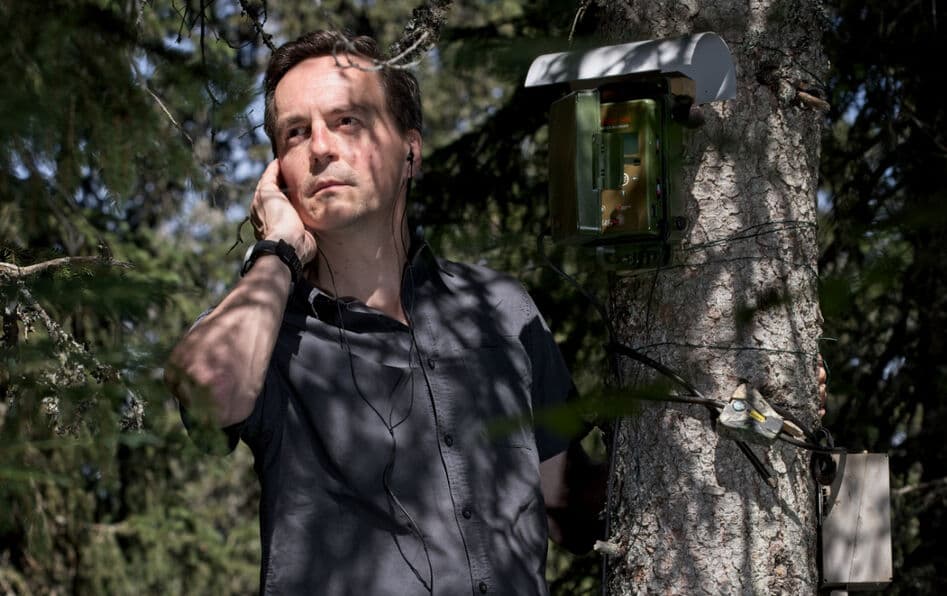 L'éco-acousticien Jérôme Sueur dans la forêt du Risoux, dans le parc naturel régional du Haut-Jura © Jean Baptiste Strobel
Back then, bioacoustics was already a well-established discipline, which refers to the analysis of sound production in animals to better understand their behavior. A few researchers had however already started to use these sounds as indicators of the presence of specific species. This passive acoustic monitoring method originated during the Second World War, when submarine military surveillance was in full development, with the goal to better comprehend underwater soundscapes. These practices were only applied to terrestrial environments in the 2010s, when the first tape recorders were installed in forests and other natural environments. A few colleagues and myself started using these recorded sounds, not to analyze the behavior of individuals, but rather to develop a listening knowledge of these ecosystems, their structure, composition and evolution, especially in regards to potential disturbances. In order to do this, we had to establish measurement criteria beforehand to qualify these sound recordings – but without the ability to specifically identify the species, as we didn’t have the right tool yet. The birth of ecoacoustics dates back to a symposium I organized in 2014 at the Muséum national d’Histoire naturelle, together with my colleague Almo Farina from the University of Urbino in Italy. This symposium was originally intended to focus on the concept of “Soundscape Ecology”, but because the term did not encompass all the topics covered by the different talks, I suggested that of “ecoacoustics”, which everybody agreed on.
How does the project at the CNRS station of Nouragues in French Guiana, which Sébastien Gaxie later joined, fit into your research activities?
We started with a project focusing on monitoring the evolution of the soundscape of a forest located in Jura, using four microphones installed 2.5 meters above the ground that recorded for one minute every fifteen minutes. Since then, we have installed a similar equipment in more than a hundred forests in mainland France and in Corsica. Conducting such research in a tropical forest however entailed completely different issues and challenges.
Is recording for one minute every fifteen minutes sufficient sampling?
It depends what you are focusing on. Here, we are interested in how the environment evolves in the long run, year after year. For this purpose, one minute every fifteen minutes is more than enough, perhaps even too much. If our topic of research was for instance animal cycles, we might need more, or at least more concentrated, data: to analyze birdsong in the morning, we would need to record for a longer time at that specific time of day. But in this case, our concern is mainly quantitative: we need to extract relevant metrics that can test our hypotheses.
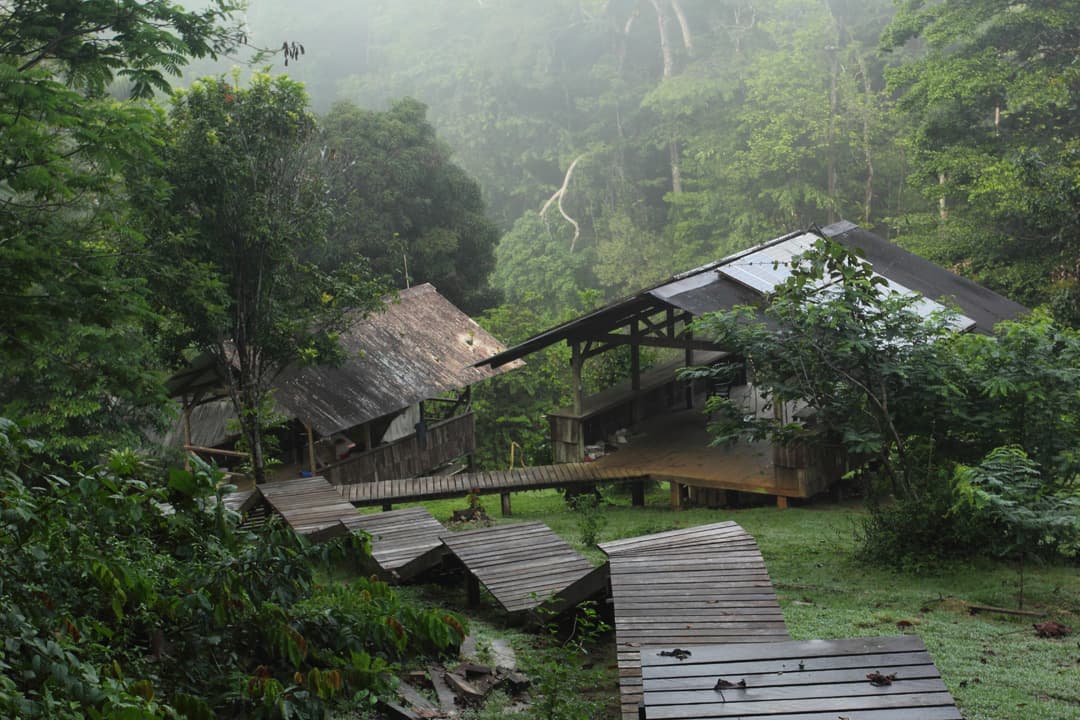 Station CNRS des Nouragues en Guyane © Quentin Martinez
This must represent a substantial amount of data! Before Sébastien Gaxie joined the project, how were you planning on processing this data?
We developed several analysis techniques that allowed us to qualify the recordings globally. For instance, we imagined “ecoacoustic indicators” that would measure the sound complexity of a recording. Nowadays, our approaches involve more often the use of artificial intelligence, but those are not yet sufficiently efficient when dealing with tropical forest soundscapes, the complexity of which is unparalleled.
So, you were collecting data, in the hope that one day you would have the tools necessary to process it?
In a sense, yes. The data can precede the tools or the studies analyzing it. That is more or less the case of the Muséum national d’Histoire naturelle, where the collected specimen can wait for dozens, or even hundreds of years before someone decides to study them! This data is a sort of scientific capital that might be valued at a later time. This project also has a memorial dimension: we record these forests before they can change too much, or potentially disappear. We are collecting archives, an approach which fits within the process of patrimonialization of the collections of the Muséum national d’Histoire naturelle.
Would you have thought of contacting IRCAM if Sébastien Gaxie had not suggested it?
To be honest, I don’t think so! I am however delighted of this opportunity to discuss with other professionals from the musical field. It’s an occasion to broaden our minds! Sébastien has started sorting out our tropical recordings, using remarkable exploration tools developed by researchers at IRCAM, such as Rémi Mignot and Diemo Schwarz. These tools will allow us to go much faster and much further! As we don’t really know how to deal with this amount of data on our own, these tools help us compile the content and lead us in the right direction; they offer a dynamic and interactive map of the database, allowing us to explore it at will. Everybody at the lab cannot wait to take a break from numbers for a while and take the time to listen again. Moreover, listening is absolutely necessary for us to be able to identify interesting data and feed it to the machine so that it can in turn learn it, and we can then monitor how it processes it. Later, we could use these tools to supplement the ones we are already using, and more specifically those dedicated to identifying specific ecological data. I am convinced that they will be very useful to us in other projects, beyond the one in French Guiana. If they prove to be efficient to analyze datasets as complicated as the ones we collected in a tropical forest, they will most probably be even more so in the case of less dense soundscapes.
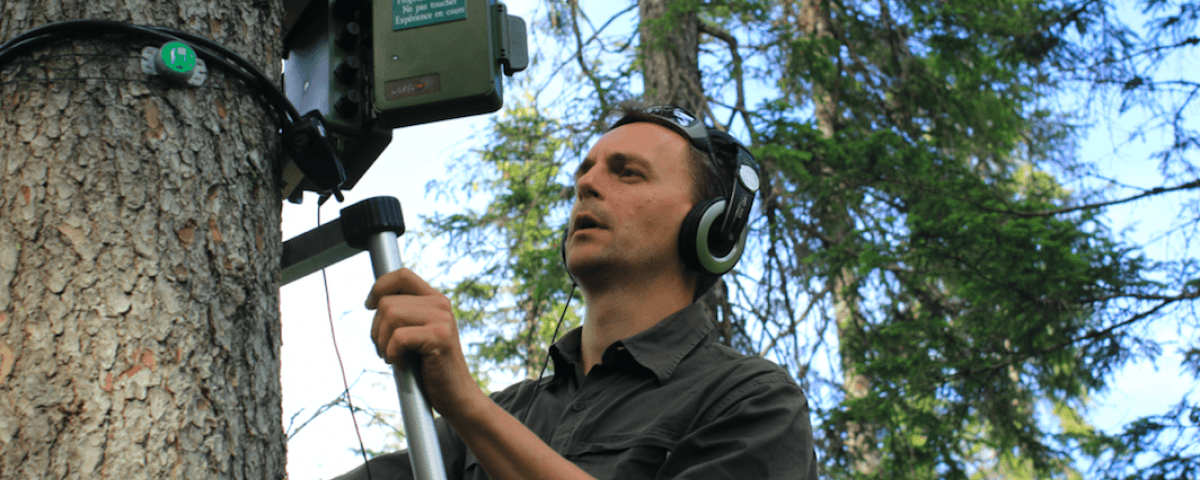 L'éco-acousticien Jérôme Sueur © F. Sèbe
During his stay at the Nouragues station, Sébastien Gaxie recorded over fifteen hours of Ambisonic sound.
He did indeed, and I was with him for most of these sessions. It was a wonderful experience and these recordings are extraordinary. From a scientific standpoint, there is not much that we can do with them, because they remain punctual observations – qualified as “opportunistic” by scientists, due to the fact they are not repeated in time and don’t follow a standard protocol. I am nevertheless able to appreciate the aesthetical and emotional value of that data – as opposed to scientific data that has no point being aesthetically pleasing.
If we were to set up a protocol (for instance one minute every fifteen minutes), would Ambisonic recordings then have a scientific value?
It certainly would! Maud Biscarat, a PhD student at the École Centrale de Lyon, is focusing on this potential, and more particularly on solutions to miniaturize and improve the reliability of these processes. As of now, our recordings are omnidirectional, which means that we have no idea where sounds are coming from. Ambisonic recordings would give us more information on how the populations we are monitoring are distributed in the environment – which would greatly improve our analysis and could even allow us to count and chart individuals.
Have you been involved in other similar projects involving arts and sciences?
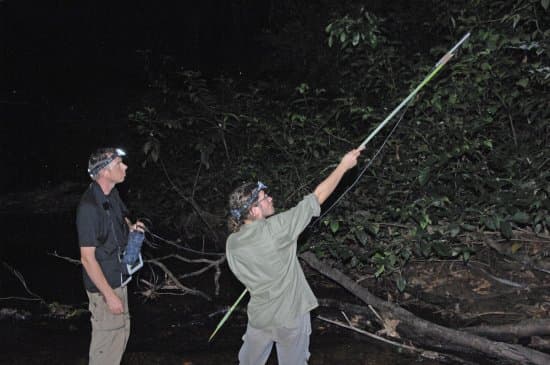 Écoute des sons enregistrés par un dispositif acoustique près de la station des Nouragues (Guyane française). © CNRS
Not directly, even though I find it extremely enjoyable. But I had for instance the opportunity to supervise, together with Pierre Couprie, Adèle de Baudouin’s thesis with a focus on arts and sciences, for which she composed very beautiful electroacoustic soundscapes. Another composer, Bastien David, created a wonderful electroacoustic piece for a ballet, involving recordings from the Muséum’s sound library that I had sent him. I have been following, from afar, other collaborative works conducted at the Muséum, such as Thomas Tilly’s work with amphibians from Guiana or, more recently, France Auda’s, a visual artist who is undertaking a residency at the laboratory. I am also interested in collaborations with other members of IRCAM, such as Nicolas Obin and Grégoire Lorieux. I am lucky enough to be a researcher in a field that speaks to artists, and I find myself having a growing interest for such experiences. These artistic projects are also a way for us researchers to focus more on the aesthetical dimension of our subject of study – when our scientific field tends to, on the contrary, revolve around data and statistics, alienating us from sounds. Sébastien Gaxie’s project aims at producing two completely different works – one large-scaled, for orchestra and tape and another, more intimate, involving three pianos – and I cannot wait to discover them both!
Interview conducted by Jérémie Szpirglas
The residency playlist

Agami trompette (oiseaux) - Forêt amazonienne
recorded in 2026
0:00 / 0:00
Cigale d'été - Forêt amazonienne
0:00 / 0:00

Le merle - Forêt amazonienne
0:00 / 0:00
Hurlements de singes - Forêt amazonienne, 2020
0:00 / 0:00

Le tinamou (oiseau) sous la pluie - Forêt amazonienne
0:00 / 0:00

Troglodyte arada - Forêt amazonienne
0:00 / 0:00
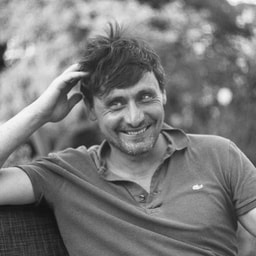
Sébastien Gaxie
Composer, pianist, and writer


