
« Détails et retailles: A Sonic Conversation with Jazz by Matisse » by Claudia Jane Scroccaro

La compositrice Claudia Jane Scroccaro
© Kristijonas Naslenas
Part of a lineage of artists who have created musical environments for exhibition spaces, Claudia Jane Scroccaro takes on a particularly ambitious challenge: the Jazz series, presented in the exhibition Matisse. 1941 – 1954 curated by Claudine Grammont at the Grand Palais. It is a formidable undertaking (and one involving many “cuttings and recuttings”), which the Italian composer embraces with boldness by transposing the tools imagined by the painter into musical composition.
Transposing Matisse's Gestures
“When I was offered the project, I didn’t hesitate for a second,” recalls Claudia Jane Scroccaro. “I’ve always loved Matisse. Of all his works, the collages from the artist’s book Jazz felt closest to what I’m interested in. Maybe that’s because, before my formal studies, my first experiences with music—very intuitive and self-taught at the time—came through jazz and pop. Just having the chance to handle the prints myself, to really see their size and texture, and to trace the lines of Matisse’s pencil with my eyes was an extraordinary experience. The text in the book is fascinating too; its content, the handwriting, the little figures that punctuate it. Seeing all of this up close changes how you perceive the work, especially when you remember that Matisse was already ill at the time.”
“The point isn’t stylistic. I wasn’t trying to write ‘jazz music’. What interested me was the process of translating Matisse’s gesture into sound—his way of generating figures, cutting them out, putting them back into play, and making them interact.”

Claudia Jane Scroccaro
Compositrice et pédagogue
This is not the first time the composer has drawn on another discipline to enrich her compositional toolkit. For I sing the body electric, Walt Whitman’s poem of the same name inspired the musical dramaturgy of the piece. More recently, in Faro, she explored the concept of portraiture as enabled by the medium of music. With Jazz, the exercise is both simplified and enriched by the very imagery of Matisse’s series, which the music is meant to accompany: the painter found in the energy of rhythm and improvisation—at once immediate and carefully worked—the spirit he wished to infuse into his cut-outs and collages.

I sing the body electric (2020)
by Claudia Jane Scroccaro, recorded in 2022
0:00 / 3:00
Accompanying the Visit
“Even though I don’t actually play jazz, I’ve been trying for a long time to borrow certain elements from it in my own music—things like groove or harmonic language,” says Claudia Jane Scroccaro. “This project gave me the chance to work with improv musicians. I invited drummer Janco Boy Bystron, trumpeter Timothée Quost, and electric guitarist Marco Fiorini—who’s also a researcher at IRCAM—to the studio for what we called the ‘Matisse Sessions’. We spent six intense days recording improvisations, sometimes together, sometimes separately, starting from fragments of scores or lead sheets I had written.”
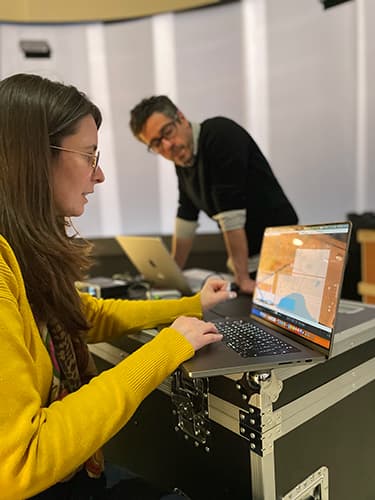 Claudia Jane Scroccaro au Grand Palais
“These sketches came from details in Matisse’s prints, somewhere between intuition and formalization—I also worked with OpenMusic—but without any attempt at literal musical illustration. Some prints really shaped my imagination, especially Le clown, Icare, Le toboggan, Les Codomas, and Le cow-boy. For Le cow-boy, for instance, I imagined a loop that creates a feeling of acceleration and deceleration, with material gradually added and removed, echoing the movement of the lasso. Another print that struck me was Le destin. Its symbolic charge made me think of the famous ‘fate knocking at the door’ from Beethoven’s Fifth Symphony—and also of Matisse’s illness.”
“The musicians took these gestures and made them their own, improvising around them to create new figures, sometimes interacting with one another. I recorded them at different speeds, a bit like Matisse recutting the same figure at different scales. Later I applied various computer processes to these recordings—cross-synthesis, loops, and so on. Even though I used very strong ‘colors’, like Matisse’s painted papers, I tried to make sure that each figure shared certain similarities—especially rhythmic ones—so that connections could emerge between the pieces accompanying prints with similar textures.”
The compositional work of Claudia Jane Scroccaro then returned to its etymological meaning of ’placing together’ all these figures, just as Matisse had done before her. “First, it was necessary to create the large-scale form—which corresponds to the blank sheet, the background—onto which I then placed the cut material, fairly intuitively, through trial and error.” This stage also required imagining how the music could accompany the visit in coherence with the architecture and acoustics of the exhibition space.
“I imagined two listening spaces. The first is more open: the listening is more distant and less demanding, so visitors can enter the space without feeling overwhelmed. Broadcast through a ring of eight loudspeakers, this twenty-five-minute form structures the space while allowing variation and counterpoint to unfold. After looking at the prints from afar, visitors can move closer—and that’s when I can offer another experience: the detail. For six of the twenty prints in the series, we installed a contact loudspeaker directly on the wooden display case. It plays a more developed musical layer that focuses on the identity of that specific print, while remaining perfectly connected to the overall form.”
By Jérémié Szpirglas

Extrait n°1
by Claudia Jane Scroccaro, recorded in 2026
0:00 / 0:00

Extrait n°2
by Claudia Jane Scroccaro, recorded in 2026
0:00 / 0:00

Claudia Jane Scroccaro
Compositrice et pédagogue
Related to this event
Mar 24, 2026
Grand Palais, galerie 3 et 4


